
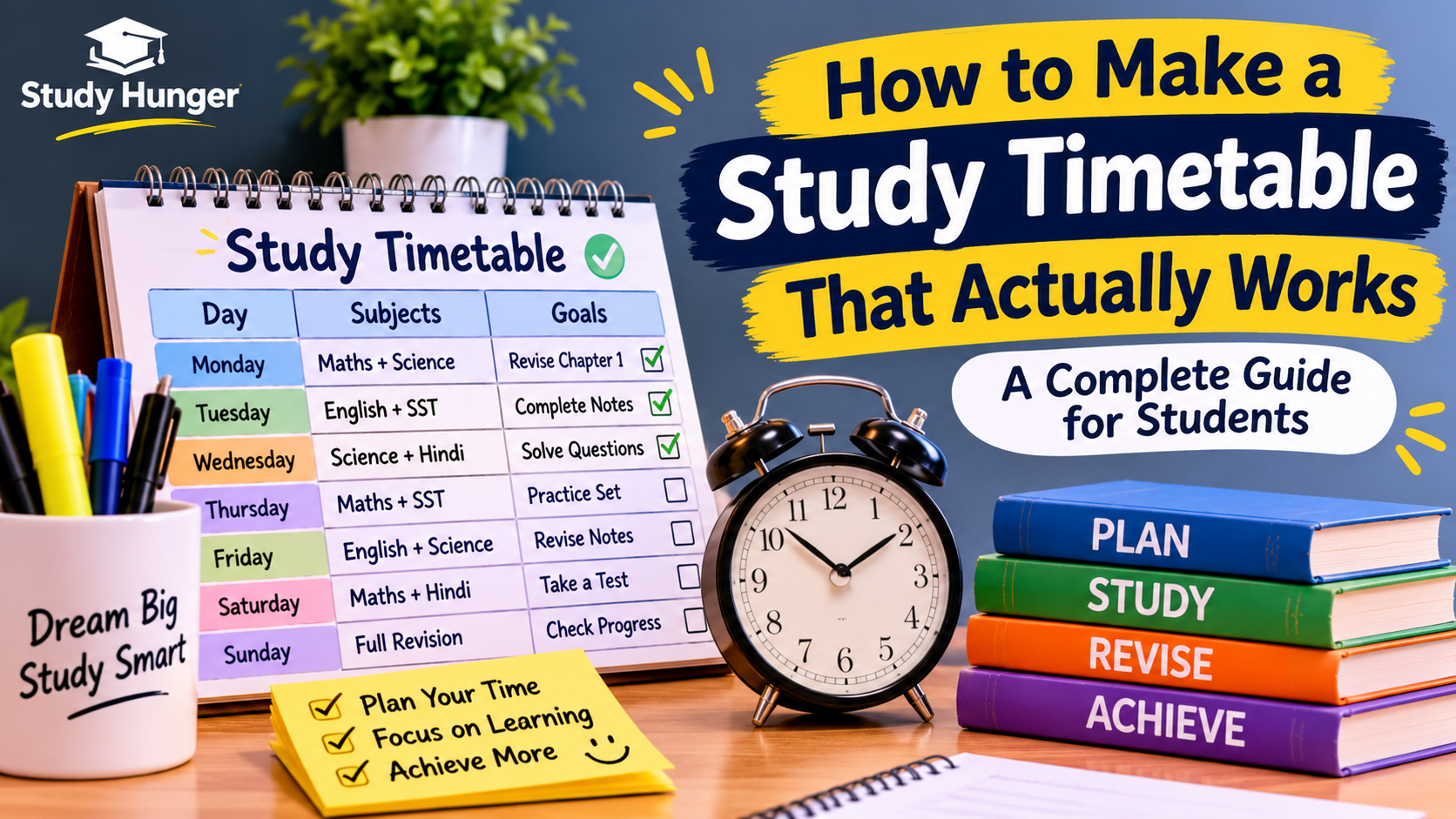
How to Make a Study Timetable That Actually Works – A Complete Guide for Students
Do you sometimes feel that there are not enough hours in the day to complete your homework, revise your lessons and prepare for examinations? You are not alone. Many students struggle to manage their study time.
One useful solution is creating a study timetable. However, simply writing subjects and timings on paper is not enough. A good timetable should be realistic, flexible and suitable for your daily routine.
In this guide, you will discover how to create a study timetable that helps you organise your schoolwork, avoid unnecessary pressure and develop better learning habits.
1. Understand Why You Need a Study Timetable
A study timetable is a plan that shows when you will complete different learning activities.
Without a plan, students may spend too much time on one subject and forget about other important subjects. They may also postpone difficult chapters until examination time.
A timetable can help you:
- Organise different subjects.
- Remember homework and assignments.
- Make time for revision.
- Identify unfinished topics.
- Balance schoolwork and free time.
- Develop consistent study habits.
Remember that a timetable is a guide, not a strict rulebook. You should be able to adjust it when necessary.
2. List All Your Subjects
Before creating your timetable, write down every subject you study.
For example:
- Mathematics
- Science
- English
- Social Science
- History
- Geography
- Languages
Next, identify which subjects require more attention.
For example, if you find mathematics difficult, you might give it additional practice sessions. If you understand English well, you may need less revision time for it.
3. Choose a Realistic Study Time
Do not create a timetable that requires you to study continuously for many hours after school.
Consider your school hours, homework, meals, rest, hobbies and sleep schedule.
Choose study sessions that fit comfortably into your day.
For example, a student who returns home in the afternoon might study after taking a break and completing necessary daily activities.
Consistency is more useful than creating an unrealistic timetable that becomes difficult to follow.
4. Divide Your Study Time Into Sessions
Instead of studying one subject for several hours, divide your study time into manageable sessions.
Here is an example:
| Activity | Duration |
|---|---|
| Mathematics practice | 30 minutes |
| Short break | 5 minutes |
| Science revision | 30 minutes |
| Short break | 5 minutes |
| English homework | 25 minutes |
| Daily revision | 15 minutes |
You can change these durations depending on your concentration and workload.
5. Give Difficult Subjects More Attention
Every student has subjects that feel easier and subjects that require additional practice.
Do not make the mistake of studying only your favourite subjects.
Try this simple method:
- Identify your three most challenging subjects.
- Give them regular practice sessions.
- Write down questions you cannot solve.
- Ask your teacher for help when necessary.
- Review your progress every week.
Giving difficult subjects regular attention can help you gradually improve your understanding.
6. Include Revision in Your Timetable
One common mistake students make is planning time only for new chapters.
Learning a new topic is important, but revisiting previously studied information is also necessary.
Include short revision sessions in your weekly timetable.
Try these methods:
- Close your textbook and recall important points.
- Answer questions without looking at notes.
- Create flashcards for definitions.
- Explain difficult concepts in your own words.
- Take small practice tests.
These activities help you check what you actually remember instead of simply recognising information while reading.
7. Keep Time for Breaks and Rest
A timetable should not contain only study activities.
Breaks allow you to relax between learning sessions. You can walk around, stretch, drink water or spend a little time on a hobby.
Also, maintain a regular sleep routine. Sleep supports concentration, memory and learning.
Do not sacrifice your health just to complete every task on a timetable.
8. Avoid Making These Timetable Mistakes
Even a well-designed timetable can fail if it is unrealistic.
Watch out for these common mistakes:
- Too many subjects: Trying to complete everything in one evening can become overwhelming.
- No breaks: Continuous studying can make concentration difficult.
- No revision: Learning new chapters without revisiting old ones is not a balanced approach.
- Unrealistic timings: Giving yourself too little time for difficult topics creates unnecessary pressure.
- Ignoring unfinished tasks: Always review what you could not complete.
- No flexibility: Unexpected homework or school activities may require changes.
9. Review Your Timetable Every Week
Your timetable should improve as you understand your study habits.
At the end of each week, ask yourself:
- Which subjects did I complete?
- Which topics still need revision?
- Did I give enough time to difficult subjects?
- Were my study sessions realistic?
- What should I change next week?
Use your answers to improve the next week’s schedule.
10. Your Seven-Day Study Timetable Challenge
Want to start organising your study routine? Try this seven-day challenge.
Day 1: Write down all your subjects.
Day 2: Identify the subjects that need more attention.
Day 3: Create a simple daily timetable.
Day 4: Follow your timetable and include breaks.
Day 5: Add a revision session.
Day 6: Check your completed and unfinished tasks.
Day 7: Review your timetable and improve it.
Conclusion
A good study timetable does not need complicated designs or strict schedules. It needs realistic goals, organised subjects, regular revision and enough time for rest.
Start with a simple plan. Follow it consistently, identify what works and make improvements whenever necessary.
Remember that the purpose of a timetable is not to keep you busy every minute. It is to help you use your available time more effectively.
Plan your time. Focus on learning. Build better habits.
About Study Hunger
Study Hunger is an educational initiative focused on helping students improve their study habits, discover effective revision techniques and make learning more organised.
Our goal is to encourage students to learn with understanding, confidence and consistency.
Study smart. Keep growing.
Leave a Reply