
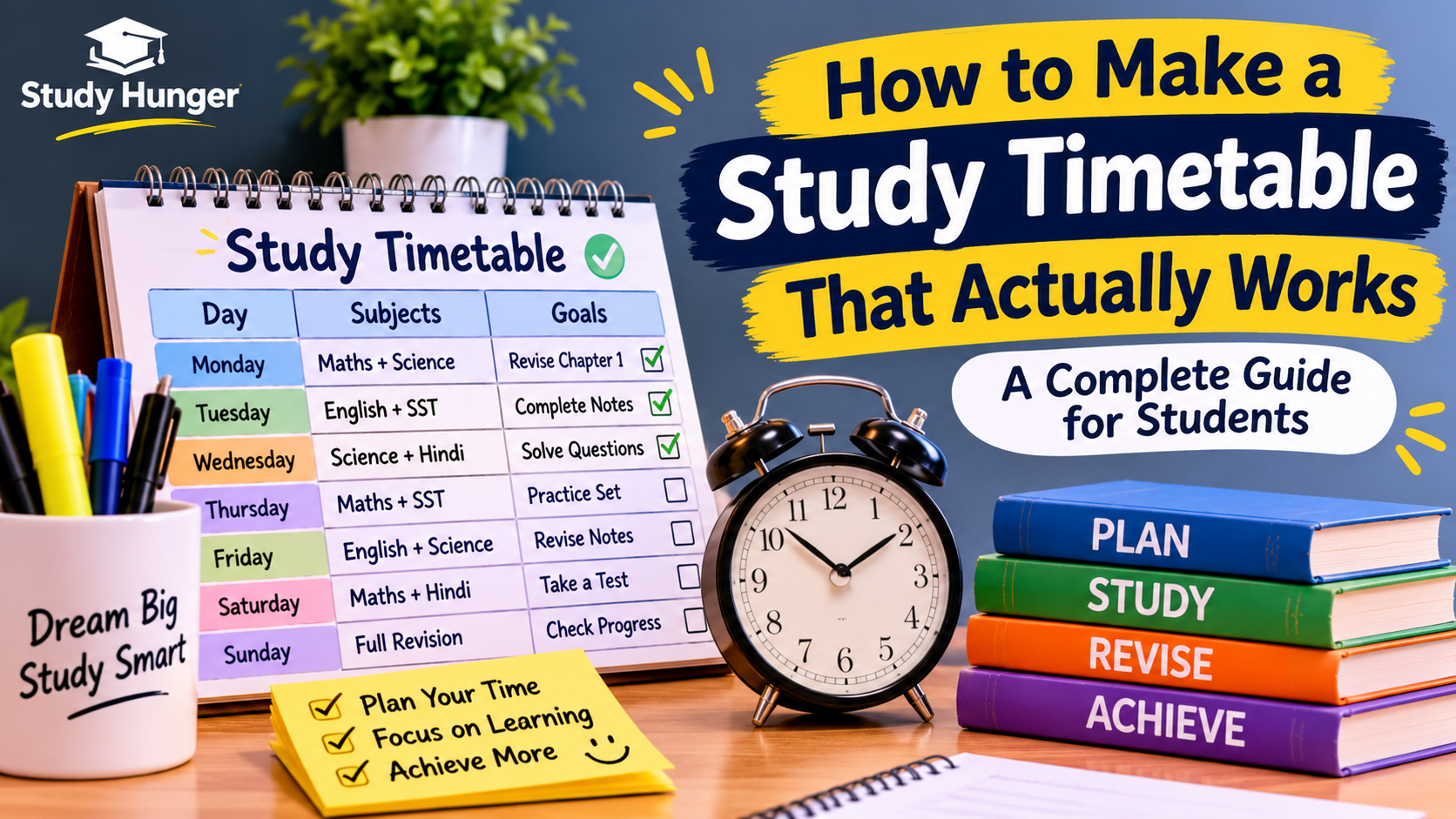
• How to Make a Study Timetable That Actually Works – A Complete Guide for Students

    How to Make a Study Timetable That Actually Works – A Complete Guide for Students

    How to Make a Study Timetable That Actually Works – A Complete Guide for Students

    Do you sometimes feel that there are not enough hours in the day to complete your homework, revise your lessons and prepare for examinations? You are not alone. Many students struggle to manage their study time.

    One useful solution is creating a study timetable. However, simply writing subjects and timings on paper is not enough. A good timetable should be realistic, flexible and suitable for your daily routine.

    In this guide, you will discover how to create a study timetable that helps you organise your schoolwork, avoid unnecessary pressure and develop better learning habits.

    1. Understand Why You Need a Study Timetable

    A study timetable is a plan that shows when you will complete different learning activities.

    Without a plan, students may spend too much time on one subject and forget about other important subjects. They may also postpone difficult chapters until examination time.

    A timetable can help you:

    • Organise different subjects.
    • Remember homework and assignments.
    • Make time for revision.
    • Identify unfinished topics.
    • Balance schoolwork and free time.
    • Develop consistent study habits.

    Remember that a timetable is a guide, not a strict rulebook. You should be able to adjust it when necessary.

    2. List All Your Subjects

    Before creating your timetable, write down every subject you study.

    For example:

    • Mathematics
    • Science
    • English
    • Social Science
    • History
    • Geography
    • Languages

    Next, identify which subjects require more attention.

    For example, if you find mathematics difficult, you might give it additional practice sessions. If you understand English well, you may need less revision time for it.

    Useful tip: Give extra attention to subjects that you find challenging, but do not completely ignore the subjects you already understand.

    3. Choose a Realistic Study Time

    Do not create a timetable that requires you to study continuously for many hours after school.

    Consider your school hours, homework, meals, rest, hobbies and sleep schedule.

    Choose study sessions that fit comfortably into your day.

    For example, a student who returns home in the afternoon might study after taking a break and completing necessary daily activities.

    Consistency is more useful than creating an unrealistic timetable that becomes difficult to follow.

    4. Divide Your Study Time Into Sessions

    Instead of studying one subject for several hours, divide your study time into manageable sessions.

    Here is an example:

    Activity Duration
    Mathematics practice 30 minutes
    Short break 5 minutes
    Science revision 30 minutes
    Short break 5 minutes
    English homework 25 minutes
    Daily revision 15 minutes

    You can change these durations depending on your concentration and workload.

    5. Give Difficult Subjects More Attention

    Every student has subjects that feel easier and subjects that require additional practice.

    Do not make the mistake of studying only your favourite subjects.

    Try this simple method:

    1. Identify your three most challenging subjects.
    2. Give them regular practice sessions.
    3. Write down questions you cannot solve.
    4. Ask your teacher for help when necessary.
    5. Review your progress every week.

    Giving difficult subjects regular attention can help you gradually improve your understanding.

    6. Include Revision in Your Timetable

    One common mistake students make is planning time only for new chapters.

    Learning a new topic is important, but revisiting previously studied information is also necessary.

    Include short revision sessions in your weekly timetable.

    Try these methods:

    • Close your textbook and recall important points.
    • Answer questions without looking at notes.
    • Create flashcards for definitions.
    • Explain difficult concepts in your own words.
    • Take small practice tests.

    These activities help you check what you actually remember instead of simply recognising information while reading.

    7. Keep Time for Breaks and Rest

    A timetable should not contain only study activities.

    Breaks allow you to relax between learning sessions. You can walk around, stretch, drink water or spend a little time on a hobby.

    Also, maintain a regular sleep routine. Sleep supports concentration, memory and learning.

    Do not sacrifice your health just to complete every task on a timetable.

    8. Avoid Making These Timetable Mistakes

    Even a well-designed timetable can fail if it is unrealistic.

    Watch out for these common mistakes:

    • Too many subjects: Trying to complete everything in one evening can become overwhelming.
    • No breaks: Continuous studying can make concentration difficult.
    • No revision: Learning new chapters without revisiting old ones is not a balanced approach.
    • Unrealistic timings: Giving yourself too little time for difficult topics creates unnecessary pressure.
    • Ignoring unfinished tasks: Always review what you could not complete.
    • No flexibility: Unexpected homework or school activities may require changes.

    9. Review Your Timetable Every Week

    Your timetable should improve as you understand your study habits.

    At the end of each week, ask yourself:

    • Which subjects did I complete?
    • Which topics still need revision?
    • Did I give enough time to difficult subjects?
    • Were my study sessions realistic?
    • What should I change next week?

    Use your answers to improve the next week’s schedule.

    10. Your Seven-Day Study Timetable Challenge

    Want to start organising your study routine? Try this seven-day challenge.

    Day 1: Write down all your subjects.

    Day 2: Identify the subjects that need more attention.

    Day 3: Create a simple daily timetable.

    Day 4: Follow your timetable and include breaks.

    Day 5: Add a revision session.

    Day 6: Check your completed and unfinished tasks.

    Day 7: Review your timetable and improve it.

    Conclusion

    A good study timetable does not need complicated designs or strict schedules. It needs realistic goals, organised subjects, regular revision and enough time for rest.

    Start with a simple plan. Follow it consistently, identify what works and make improvements whenever necessary.

    Remember that the purpose of a timetable is not to keep you busy every minute. It is to help you use your available time more effectively.

    Plan your time. Focus on learning. Build better habits.

    About Study Hunger

    Study Hunger is an educational initiative focused on helping students improve their study habits, discover effective revision techniques and make learning more organised.

    Our goal is to encourage students to learn with understanding, confidence and consistency.

    Study smart. Keep growing.

  • How to Study When you Have No Motivation

    How to Study When you Have No Motivation

    How to Study When You Have No Motivation: 10 Practical Tips for Students

    Have you ever opened your textbook, looked at the chapters and immediately felt like doing something else? You know that studying is important, but finding the motivation to begin feels difficult.

    This experience is common among students. Sometimes you feel energetic and ready to learn. On other days, even starting one page seems challenging.

    The solution is not to wait until you suddenly feel motivated. Instead, develop simple study habits that help you begin even when motivation is low.

    1. Start With Just Five Minutes

    One of the biggest difficulties is getting started. Thinking about completing an entire chapter can make studying feel overwhelming.

    Instead, make a small promise to yourself: study for just five minutes.

    • Open your textbook.
    • Read one small section.
    • Write down one important point.
    • Try one practice question.

    Once you begin, continuing may feel easier. Even if you stop after five minutes, you have made a start.

    Remember: You do not have to finish everything today. Focus on beginning one small task.

    2. Set Clear and Small Goals

    Vague goals such as “I will study science” do not tell you exactly what to do.

    Make your goals specific and achievable.

    Instead of writing:

    Study mathematics.

    Write:

    Complete five algebra questions and check the answers.

    Clear goals make it easier to understand what you need to accomplish.

    3. Create a Comfortable Study Environment

    Your surroundings can influence your concentration.

    Before studying, prepare a simple workspace.

    • Keep your textbook and notebook nearby.
    • Arrange your stationery.
    • Remove unnecessary items from your desk.
    • Keep your phone away from distractions.
    • Choose a comfortable place with sufficient light.

    You do not need an expensive study room. A clean and organised corner can be enough.

    4. Use the 25-Minute Study Method

    Try dividing your study time into shorter sessions.

    Example:

    • 25 minutes: Focused studying.
    • 5 minutes: Short break.
    • 25 minutes: Continue studying.
    • 5 minutes: Another short break.

    You can adjust the timings depending on your concentration and the difficulty of the subject.

    5. Make Studying More Interesting

    Studying does not always have to mean reading long paragraphs.

    Try different learning activities:

    • Turn important facts into questions.
    • Draw diagrams to understand concepts.
    • Use flashcards for definitions.
    • Explain lessons in your own words.
    • Create small quizzes after completing a chapter.

    Changing your learning method can make studying more engaging.

    6. Keep Your Daily Progress Visible

    Sometimes students feel that they are not making progress because they do not track what they have completed.

    Create a simple checklist.

    • Complete one science topic.
    • Revise five important definitions.
    • Solve five mathematics questions.
    • Read one English lesson.

    Mark tasks as completed only after actually finishing them. Honest progress tracking helps you understand your learning habits.

    7. Avoid Comparing Your Progress With Others

    Every student has a different learning speed, strengths and difficulties.

    Comparing your daily progress with classmates can create unnecessary pressure.

    Instead, compare your current understanding with what you knew previously.

    Ask yourself:

    • Did I understand something new today?
    • Did I correct a mistake?
    • Did I improve my revision method?

    Small improvements are meaningful steps in learning.

    8. Give Yourself Proper Breaks

    Studying continuously without resting can make concentration difficult.

    Take short breaks between study sessions. Walk around, stretch, drink water or relax for a few minutes.

    Try not to let a short break become an hour of scrolling through social media.

    9. Remember Why You Are Studying

    Think about what you want to achieve through education.

    Perhaps you want to understand science better, improve your examination results, learn a new skill or prepare for a future career.

    Write down one meaningful learning goal and keep it somewhere visible.

    Your goal does not need to be extraordinary. It should simply give your daily efforts a direction.

    10. Build Consistency Instead of Waiting for Motivation

    Motivation naturally changes from day to day. A good study routine should not depend entirely on how motivated you feel.

    Choose a realistic time for studying and try to follow it regularly.

    Start with manageable tasks and gradually develop a routine that fits your school schedule.

    Your Seven-Day Study Consistency Challenge

    Try this simple challenge to build better study habits.

    Day 1: Study for five focused minutes.

    Day 2: Write three small study goals.

    Day 3: Organise your study space.

    Day 4: Try a 25-minute study session.

    Day 5: Use active recall to revise a topic.

    Day 6: Complete a small self-test.

    Day 7: Review your progress and plan your next week.

    Conclusion

    You do not need to feel motivated every single day to become a better learner.

    Start with small tasks, create realistic goals, organise your surroundings and develop a consistent routine.

    Remember that progress is not always about studying for more hours. It is also about learning effectively and taking care of yourself.

    Start small. Stay consistent. Keep learning.

    About Study Hunger

    Study Hunger is an educational initiative focused on helping students improve their study habits, discover effective revision techniques and make learning more organised.

    Study smart. Keep growing.

  • Why Do Students Forget What They Study? 10 Effective Ways to Remember Lessons Longer

    Why Do Students Forget What They Study? 10 Effective Ways to Remember Lessons Longer

    Why Do Students Forget What They Study? 10 Effective Ways to Remember Lessons Longer

    Study Hunger | Study Tips | Memory Improvement

    Student learning memory improvement techniques using books and interactive study tools

    Have you ever studied a chapter carefully, understood everything, and then forgotten the answers during a test?

    You are not alone. Many students experience this problem. They spend hours reading textbooks, highlighting important sentences, and memorising answers, but struggle to remember the information later.

    The problem is not necessarily that students have poor memory. Often, they simply use study methods that do not help them remember information for long.

    Learning is not just about reading something repeatedly. It is about understanding, practising, recalling, and revising information regularly.

    1. Why Do Students Forget What They Study?

    There are several reasons why students forget information after studying.

    Lack of revision

    Studying a topic once does not guarantee that you will remember it forever. Without revisiting information, it can become harder to recall.

    Passive learning

    Reading the same paragraph repeatedly may make it feel familiar, but familiarity is not the same as remembering.

    Lack of understanding

    Memorising answers without understanding their meaning can make learning difficult, especially when examination questions are presented differently.

    Distractions

    Constant interruptions can make it harder to concentrate and understand new information.

    Studying too much at once

    Trying to learn many topics in one sitting can make revision difficult to manage.

    2. Use Active Recall

    Active recall is one of the most useful learning techniques. Instead of simply reading your textbook again, close the book and try to remember what you have learned.

    For example, after studying photosynthesis:

    • Read the science topic carefully.
    • Close your textbook.
    • Explain photosynthesis in your own words.
    • Check your textbook to identify anything you missed.

    This technique gives your brain an opportunity to practise retrieving information from memory.

    Study Hunger Tip: After completing every topic, ask yourself three questions without looking at your notes.

    3. Follow Spaced Revision

    Do not wait until the night before an examination to revise everything. Instead, revisit topics at increasing intervals.

    DayRevision Activity
    Day 1Learn the topic.
    Day 2Revise it briefly.
    Day 4Test your memory.
    Day 7Revise again.
    Day 14Take a short practice test.

    Adjust this schedule depending on how difficult the topic is. Regular revision helps you identify what you remember and what needs more practice.

    4. Understand Before Memorising

    Imagine learning a mathematical formula without knowing what it means. You might remember it temporarily, but applying it to a different question could become difficult.

    Try to understand the concept first. Ask yourself:

    • What does this concept mean?
    • Why does it happen?
    • Can I explain it using a simple example?
    • Where can I apply it?

    Understanding makes it easier to connect new information with what you already know.

    5. Turn Lessons Into Questions

    Transform textbook headings into questions. This makes revision more active and helps you check your understanding.

    Textbook HeadingPractice Question
    PhotosynthesisWhat is photosynthesis?
    Water CycleHow does the water cycle work?
    ParliamentWhat are the functions of Parliament?
    FractionsHow do we add fractions?

    Answer these questions without looking at your notes. Check your answers afterwards and correct any mistakes.

    6. Use Mind Maps

    Mind maps help organise information visually. Write the main topic in the centre of a page and create branches for important ideas, definitions, examples, and facts.

    For example, a mind map about the human digestive system can include:

    • Mouth
    • Oesophagus
    • Stomach
    • Small intestine
    • Large intestine

    Use short keywords rather than copying entire textbook paragraphs. You can also use simple drawings and connecting arrows to make relationships clearer.

    7. Practise With Quizzes

    Quizzes are a simple way to check your understanding. After completing a chapter, answer questions about the topic.

    Try different question formats:

    • Multiple-choice questions
    • True or false questions
    • Fill in the blanks
    • Short-answer questions
    • Application-based questions

    Start with easy questions and gradually move towards more challenging ones.

    Always review your incorrect answers. Mistakes can show you which concepts need more attention.

    8. Explain What You Learn

    Try teaching a topic to someone else. You do not need to be a teacher. Explain the topic to a friend, family member, or even yourself.

    For example, after studying the solar system, explain the difference between planets, stars, and satellites.

    If you cannot explain an idea clearly, revisit that part of the lesson. Teaching is also a useful way to discover gaps in your understanding.

    9. Take Breaks and Maintain Healthy Study Habits

    Studying continuously without breaks can make learning tiring. Create a balanced study routine that includes:

    • Short breaks between study sessions.
    • Enough sleep.
    • Regular physical activity.
    • Drinking enough water.
    • A comfortable and organised study environment.

    Remember, effective learning is not about studying every minute. It is about making your study time meaningful.

    10. Make Learning Interesting

    Learning does not always have to involve textbooks and notebooks. You can make studying more engaging through different activities.

    • Educational games
    • Interactive quizzes
    • Flashcards
    • Science experiments
    • Educational videos
    • Group discussions

    When you actively participate in learning, you get more opportunities to practise and understand concepts.

    A Simple Daily Revision Routine

    Here is an example of a manageable study routine:

    ActivityTime
    Learn a new topic25 minutes
    Short break5 minutes
    Active recall10 minutes
    Practice quiz10 minutes
    Review mistakes10 minutes

    You can adjust the timings according to your school schedule, subject, and learning needs.

    Final Thoughts

    Forgetting what you study is a common learning challenge, but you can improve your ability to remember information through better study habits.

    Start with active recall, revise regularly, understand concepts, practise questions, and make learning interesting.

    Do not measure your progress only by how many hours you study. Pay attention to what you can understand, explain, and remember.

    Study Hunger — Learn Smart. Play Smart. Remember More.

    Start with one new study technique today. Small improvements in your learning habits can make a meaningful difference over time.

    Frequently Asked Questions

    1. Why do I forget everything after studying?

    You may not be revising regularly or practising recalling information. Try active recall and spaced revision.

    2. How can I remember lessons for a long time?

    Understand the concepts, test yourself regularly, and revisit difficult topics over time.

    3. Is reading the same chapter repeatedly effective?

    Repeated reading can help with familiarity, but combining it with practice questions and active recall is more useful for checking what you actually remember.

    4. How often should students revise?

    A practical starting point is to revise the next day, then after a few days, and again the following week.

    5. What is the best way to prepare for examinations?

    Understand your syllabus, create a revision schedule, practise questions, and review mistakes rather than relying only on last-minute memorisation.


    Published by Study Hunger

    Helping students build better study habits through smarter learning and effective revision.

    Learn Smart. Play Smart. Remember More.